Three Hidden Layers of Kanban
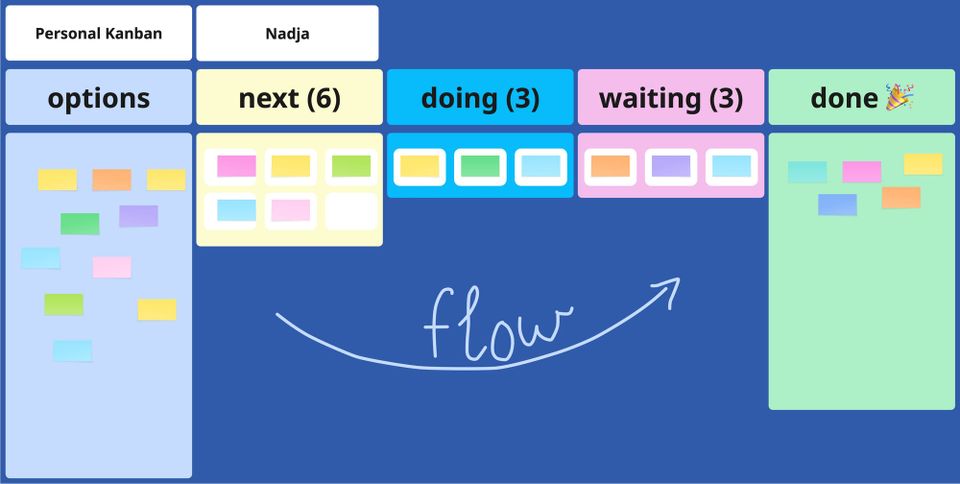
Most articles about Kanban talk about columns, sticky notes, and work-in-progress limitations. This one is about three things Kanban does underneath — and these are the reasons I still come back to Kanban, every single day.
If you want to read this text in German, use the language switcher on the right bottom of the page.
There is a sticky note on my Kanban board that has been sitting in the «doing» column for three weeks. It is a real task. It matters to me. It is important to my client. And every morning when I open my board, it looks at me a little more accusingly.
I could move it. I could shame myself for not doing it. I could also just pretend it isn't there.
Instead, the fact that it is not moving makes me think deeper what this task really means for me, how it is related to my purpose, and how I could transform it to fit my needs better.
And this is the thing that fascinates me about Kanban since I picked it up — that Kanban is never really just about work, or productivity, or flow. It is about all those things, yes. And it is about so much more.
I first picked Kanban up at BrainStore in the early 2000s, and more deeply just a year later when I sat down with Jim Benson, the author of «Personal Kanban» and one of the three pioneers of the method. I thought I was learning a productivity tool. But today I know: I was actually learning to see myself more clearly.
Below, I present three layers of what Kanban quietly does — three layers most articles about columns and post-its never mention. They are, I think, the reason it keeps mattering to me so much and keeps being one of my favorite tools to manage work and collaboration.
Kanban on the surface
Ask ten people what Kanban is and you'll hear some version of the same thing. Three columns — to do, doing, done. Sticky notes that move from left to right.
A limit on how many things you allow in the «doing» column. A visual way to organise teamwork. Something that came from Toyota. Something used by agile teams and software developers.
All of this is true. And it is also — I want to argue — just scratching the surface of Kanban. Below that surface lie three layers that most people rarely notice, and that changed my relationship with my own work and my collaboration with others.
Layer one — Kanban as an inner landscape
Here is the first surprise: the most radical thing about a Kanban board is not that other people can see your work. It is that you can see your own.
For most of us, work presents itself to us as an imprecise hunch. «I have so much on my plate.» «I'm juggling too many things.» «I don't know where to start.» These thoughts relate to feelings of overwhelm, of insecurity, of dread. But they are not precise information. The problem with such thoughts for me: They stress me out without actually helping me.
The moment you write everything down and put it on a visible board, the fog lifts. You go from «I have a million things» to «I have exactly seventeen — and I can see them all now.» The panic of the invisible pile becomes the relative calm of a precise list. And not only that: The 17 things are not just visible as a list, which can make even 17 items seem overwhelming again, but they are all placed where they belong: Stuff you could do, Stuff you plan to do next, stuff you are actually working on right now and — very soon — stuff that is actually finished.
What becomes visible in this moment is the cognitive load. Forgotten promises to yourself. Tasks you keep meaning to start but never do. Half-finished stories. Things you agreed to do for someone else that now come back at a moment that is maybe very inconvenient. Because it is visible, things start to relate to each other. Seemingly unrelated stuff suddenly becomes connected, necessary trade-offs become apparent.
For me, this was the great gift. I remember making my very first Personal Kanban after meeting Jim Benson, filling my «Options» column with every open item in my head and distributing it on my first board — and feeling something I hadn't expected. Immense relief. My mind stopped chasing. The board was carrying the count for me.
Kanban is a mirror for me before it is a method. And what it shows you is the reality of what you're actually carrying — which turns out to be less scary than the imagined weight of it.
Layer two — Kanban as a way to honor all my personalities
Work with your kanban board for two or three weeks, and something new appears: patterns.
You notice that some tasks feed each other. A morning of deep work followed by an afternoon of small wins leaves you satisfied. A whole day of small tasks leaves you empty. You notice that certain cards keep migrating between columns and never leave — those tell you something about your resistance, not your capacity.
And then a bigger pattern: the different «yous» that live on your board.
There is Coach-me and Parent-me and Writer-me and Business-me. There is Grandparent-me and Friend-me and Creative-me. Each of them wants different work, at different tempos, in different colors.
I've come to think that a Personal Kanban is really a diplomatic table where all these «mes» sit down and try not to overrun each other. Work-in-progress-limits are not about efficiency; they are about admitting that Coach-me and Writer-me can't both have the whole morning. Something has to wait. Something else has to be honored.
This is what I see as personal symbiosis: instead of one heroic «me» managing tasks, several «mes» learning to live well together. The board is where they negotiate. It is honest in a way that a calendar never is. It makes limitations visible: Not just limitations in terms of hours, but also energetic limitations, limitations of interest, of capacity and of holding space for many aspects of one person at the same time.
Layer three — Kanban as radical transparency
Now bring the same board to a team.
Suddenly, everyone's work is visible. Not aspirational, not what they want to be doing — what they actually are doing, and also what they agree on that will be important soon. This is uncomfortable in the first meeting and revolutionary by the third.
I remember a moment at Republik, a Media Startup I co-founded, about two months before the launch date: We asked all the journalists to place the stories they were working on on a Kanban board. Most articles were placed in the «idea», «research» or «writing now» column. Not one story had approached the «edit» or «ready to publish» stage. That was an inconvenient truth to see. And it made it clear that we had to get a move on now. Before that moment, everyone believed that there must be someone else who actually has a story ready to publish. Pure hope without any evidence.
Radical transparency reveals things no status meeting ever will. Who is silently overloaded. What is stuck because two people never aligned. Where «everyone is on it» actually means «no one is on it, and no one wants to be the first to admit it.» The person who says «yes» too often, whose column overflows week after week. The task that has been «in progress» for two months, waiting on one decision no one wants to make.
Radical transparency also reveals what the team is genuinely not doing. Sometimes that is the more important discovery. A team that spends six months talking about strategy but never puts strategy on its board — is it, honestly, working on strategy at all?
A team I once worked with had been «too busy for a purpose workshop» for eighteen months. In our first shared Kanban session, we put every current task on a single board and asked one question: which of these will still matter in a year?
The answer was silent and unanimous: none.
Every card was urgent. Every card would get done. Every card would be forgotten. The team wasn't lazy — they were exhausted from full-time work that would leave no trace. What no purpose workshop had managed to say, their own board said in ten minutes. Because you can argue with a workshop. You can't argue with a board full of your own tasks. It tells you, in your own handwriting, that what you are doing has no clear purpose.
The subtle move here is important. Radical transparency does not require radical honesty first. That would be too much to ask. It creates the conditions in which honesty becomes possible, because there is now a shared object to point at. You are not accusing a person; you are pointing at something visible to everyone a board.
This is why I keep coming back to Kanban twenty years later. It is not a productivity tool. It is a very small, very patient invitation to the truth.
What connects all three
Visibility. That is the whole, glorious gift of Kanban.
Kanban is a tool for making the invisible visible — to yourself, to the many yous, to the people you build with. It does not solve anything on its own. It just puts the truth on a wall or on a digital board where you can look at it and talk it out.
The rest — the columns, the post-its, the WIP-limits — are means to make this happen.
The real question Kanban asks is not «how do we organise our work?» It is: «what are we actually doing — and are we willing to look if this makes sense?»
That question, quietly asked again and again, changes how you work with yourself, with the different parts of yourself, and with the people around you. It is the small seed of a very big shift.
Three experiments to try this week
Layer one · Empty your head
- Pick a quiet moment on Sunday evening. Fifteen minutes.
- Open a fresh board — Miro, a sheet of paper, a whiteboard. The medium doesn't matter; visibility does.
- Draw four columns: Options · Next · Doing · Done.
- Now empty your mind. Every open loop. Every "I should really…". Every half-finished conversation. Every "must remember to…". One card each, in Options.
- Look at what you see. Don't move anything yet. Just count. Notice what you feel. At this stage, it is often overwhelm. Everything seems important. Now pick a maximum of 6 items intuitively and put the into the «next» column. Notice again what you feel. Now, the feeling often is relief. You know what sticks out from the many and what asks for your attention now.
Layer two · The many «yous»
- Take the board from last week, or make a fresh one.
- Choose four or five colours. Assign each to a version of you — Coach-me, Parent-me, Writer-me, Friend-me, Business-me. Use whatever fits your life.
- Colour every card according to which «you» it belongs to.
- Step back and look at the board for one full minute.
- Ask yourself: which «me» is over-represented? Which is missing? Which cards belong to two «mes» at once? Notice what surprises you.
Layer three · One visible board
- Choose one team meeting this week — even a small one, even a two-person conversation.
- Bring a visible board. A shared Miro screen. A flipchart. A wall of sticky notes.
- In the meeting, collect, together, all the things that the team is doing, could be doing, curveballs that have just arrived at the team. Distribute them, together, on the board where they currently are. Not where they should be. Where they actually are. You will — most likely — notice that way too many things are in the «doing» column. It will look insane to you all.
- Now ask «How many things can we actually have in the «doing» column now that we are actually working on and want to finish as soon as possible? And how many can there be if we want to finish them collaboratively?»
- Move everything else to the «next» or the «options» column.
- Meet again soon. My recommendation would be: The next day. Get used to the conversation.
My Closing Question
I'll leave you with the question I ask myself every week once in front of my board:
What has your Kanban shown you about yourself that you didn't want to see?
If you have an answer, I'd love to hear it. Members can share it in the comments below. I'll be reading.
🔥 For members —
the Kanban Board Library & Kanban Office Hour
If you want to bring this into your own week, I have built a small library of Kanban templates for members of the «tiny seed» and «medium seed» segment.
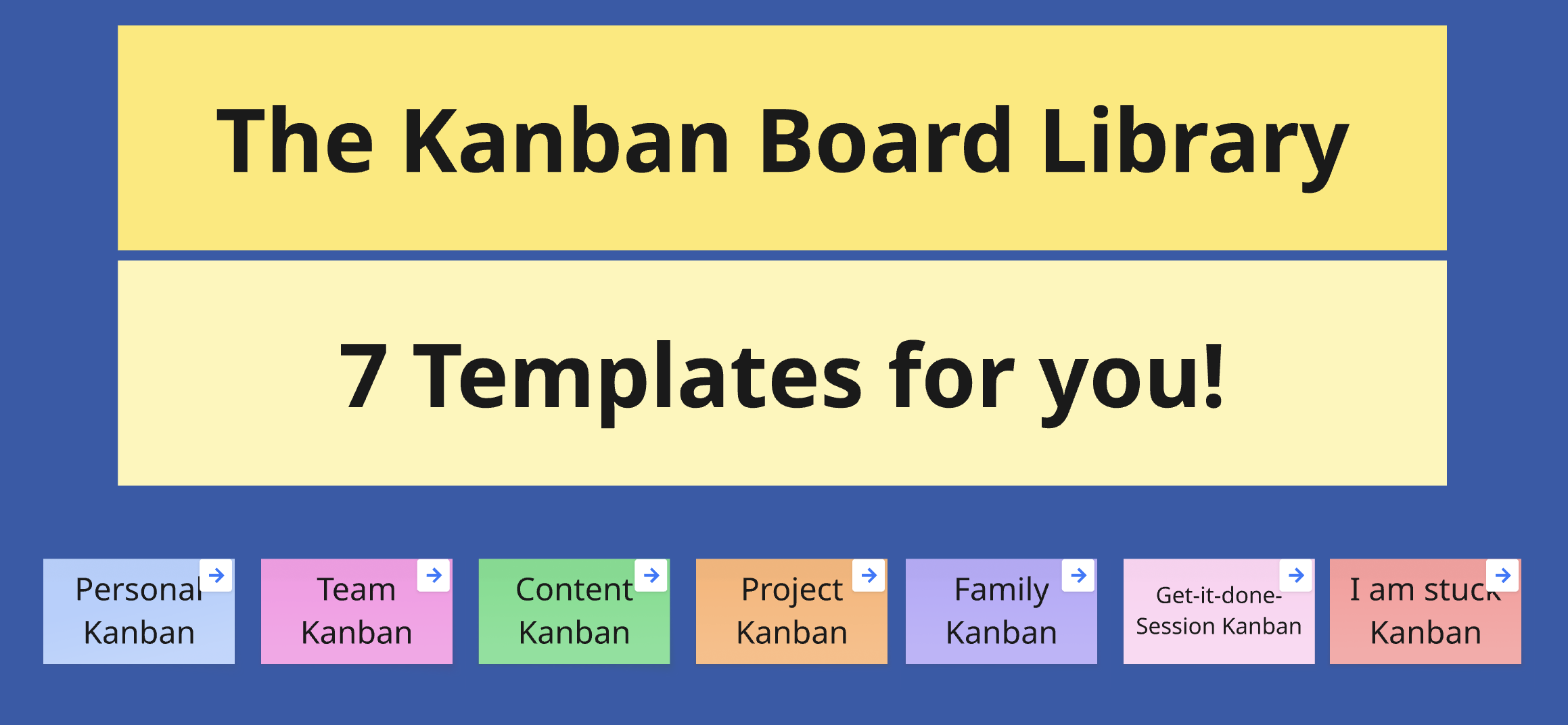
What's in the Kanban Board Library? Seven Kanban board templates you can duplicate in one click, each with a short video instruction walkthrough — three to five minutes on when and how to use these boards.
Included: Personal Kanban, Team Kanban, Content Kanban, Project Kanban,
Get-it-Done Kanban, Family Kanban, and one I haven't seen anywhere else — Kanban for Creative Blocks, a board designed not for finishing but for seeing why something won't move.
Plus, on August 4 at 6pm CET, the first Kanban Office Hour — a live thirty-minute session where we set up your first board together, no matter which of the seven you choose.
If you already booked a paid membership, you will get this automatically in a few days. If you have a free subscription, you can now book a paid membership easily!
Become a member today— get the templates & an invitation to the Kanban Office Hour.
I will share the Kanban Library on Tuesday, July 14.
Member discussion